
Price an evening dress from its landed cost, not from the supplier's invoice. Landed cost is what the piece costs you once it is on your rail: the wholesale price plus freight, insurance, customs duty and clearance. A familiar starting point is keystone pricing, which doubles that cost. That is a 100% markup and a 50% margin. Keystone is a floor rather than a rule. Evening wear carries costs that everyday clothing does not, such as try-on wear, slow sizes and end-of-season markdowns, and your price has to absorb them. This guide works through the maths with hypothetical figures you can replace with your own.
What is keystone pricing?
Keystone pricing sets the retail price at double the wholesale cost. Shopify's guide to wholesale pricing describes it as a 100% markup over the wholesale price: if a piece costs you AED 500, it goes on the rail at AED 1,000.
Its appeal is simplicity: one rule, applied to every piece, that leaves half of each sale to cover your costs and profit. Its weakness, as the same guide notes, is that it ignores competition, demand and perceived value. A hand-beaded gown and a plain satin slip bought at the same wholesale price will not command the same shelf price, and keystone treats them as if they would.
Use keystone as a floor and a quick check. If a design cannot sell at double its landed cost in your market, it is probably the wrong design for your rail.
What is the difference between margin and markup?
Both describe the same profit, measured against different numbers. Markup is profit as a share of cost. Margin is profit as a share of the selling price.
- Markup = (price − cost) ÷ cost
- Margin = (price − cost) ÷ price
- To convert a markup to a margin: margin = markup ÷ (1 + markup)
- To find the price for a target margin: price = cost ÷ (1 − margin)
Common pairs:
- 50% markup: 33.3% margin
- 100% markup (keystone): 50% margin
- 150% markup: 60% margin
- 200% markup: 66.7% margin
Mixing the two up is the most common pricing mistake. A boutique that wants a 50% margin and adds 50% to cost ends up with a third, not a half.
What goes into the landed cost of a dress?
Landed cost is every cost of getting a piece onto your rail. For a dress you import yourself, add up:
- The supplier's price for the piece.
- Freight and insurance to the GCC, shared across the pieces in the shipment.
- Customs duty. The UAE's official portal, u.ae, says tariffs range from 0 to 5%, and gives Dubai's rate as 5% of the CIF value (cost, insurance and freight).
- Clearance, courier and bank or card fees.
A hypothetical example: a dress at AED 700 from the supplier, AED 80 of freight and insurance per piece (so AED 780 CIF), AED 39 of duty and AED 31 of clearance and local delivery gives a landed cost of AED 850.
Import VAT is usually kept out of landed cost if you are VAT-registered, because the Federal Tax Authority allows a registrant to recover input tax on business purchases, provided the records and tax invoices are kept. Confirm your own position with the FTA or a tax adviser.
If you buy from a GCC distributor that delivers duty paid, your landed cost is close to the invoice price. Lianora, for example, bears customs duties and taxes on delivery.
How do you get from landed cost to a shelf price?
Decide the margin you need, work out the price before VAT, then set a VAT-inclusive price point your customers will recognise. Continuing the hypothetical AED 850 landed cost:
- Keystone (50% margin): AED 1,700 before VAT.
- 60% margin: 850 ÷ 0.4 = AED 2,125 before VAT.
- 66.7% margin (triple the cost): AED 2,550 before VAT.
In the UAE, a VAT-registered business must advertise prices that include VAT. That is Article 38 of the VAT Decree-Law, and the Federal Tax Authority's guidance applies it to price tags and catalogues. So work backwards from a round shelf price. The FTA's own shortcut, in its guide to tax obligations, is that the VAT inside a 5% VAT-inclusive price is the price divided by 21. Rules and their application can change, so confirm them with the FTA or a tax adviser.
Say you tag the dress at AED 2,100. The VAT is 2,100 ÷ 21 = AED 100, so you keep AED 2,000. On a landed cost of AED 850, that is a 57.5% margin and a 135% markup. Comfortably above keystone, and below the 60% target, so you would decide whether AED 2,200 still sells.

Why price evening wear above keystone?
Because the price you put on the tag is not the price you will get for every piece. Retailers distinguish initial markup, set when a piece is first priced, from maintained markup, the profit actually kept once it sells. Markdowns and discounts are what open the gap between the two.
In evening wear, the gap tends to come from:
- End-of-season markdowns on designs and colours that did not sell through.
- Leftover sizes once the popular ones have gone.
- Try-on wear: beading snagged, hems marked or make-up on a neckline after many fittings.
- Exchanges and returns that leave a piece out of saleable condition.
- Discounts for loyal clients, bridesmaid groups and family orders.
Your initial markup has to be high enough that, after all of these, the maintained margin still covers rent, staff and profit.
How do markdowns change your margin?
Run the numbers on a whole buy, not on a single piece. A hypothetical buy of six dresses at the AED 850 landed cost above:
- Cost of the buy: 6 × 850 = AED 5,100.
- Four sell at AED 2,100 (AED 2,000 after VAT): AED 8,000.
- Two sell at 30% off, AED 1,470 (AED 1,400 after VAT): AED 2,800.
- Net sales: AED 10,800. Gross profit: AED 5,700.
- Maintained margin: 5,700 ÷ 10,800 = 52.8%, against the 57.5% you planned on the tag.
Two pieces out of six on markdown cost nearly five points of margin. That is why buying quantity matters as much as the price tag: if those two extra pieces only came because of a quantity discount, check that the discount was bigger than the markdown. Our guide to minimum orders and tiered pricing shows how to test that before you order.

How should you price for different GCC markets?
Start from the same landed cost and margin, then adjust for each market's tax and competition.
- VAT differs. The UAE's standard rate is 5%, as the Federal Tax Authority lists it, while Saudi Arabia's is 15%, according to ZATCA. The same net price therefore gives a noticeably higher shelf price in Riyadh than in Dubai. Check the registration and display rules in each country you sell into.
- Know your local comparison. Before you set a price, look at what similar pieces sell for in your own city, in shops and on social media, so you know where yours sits.
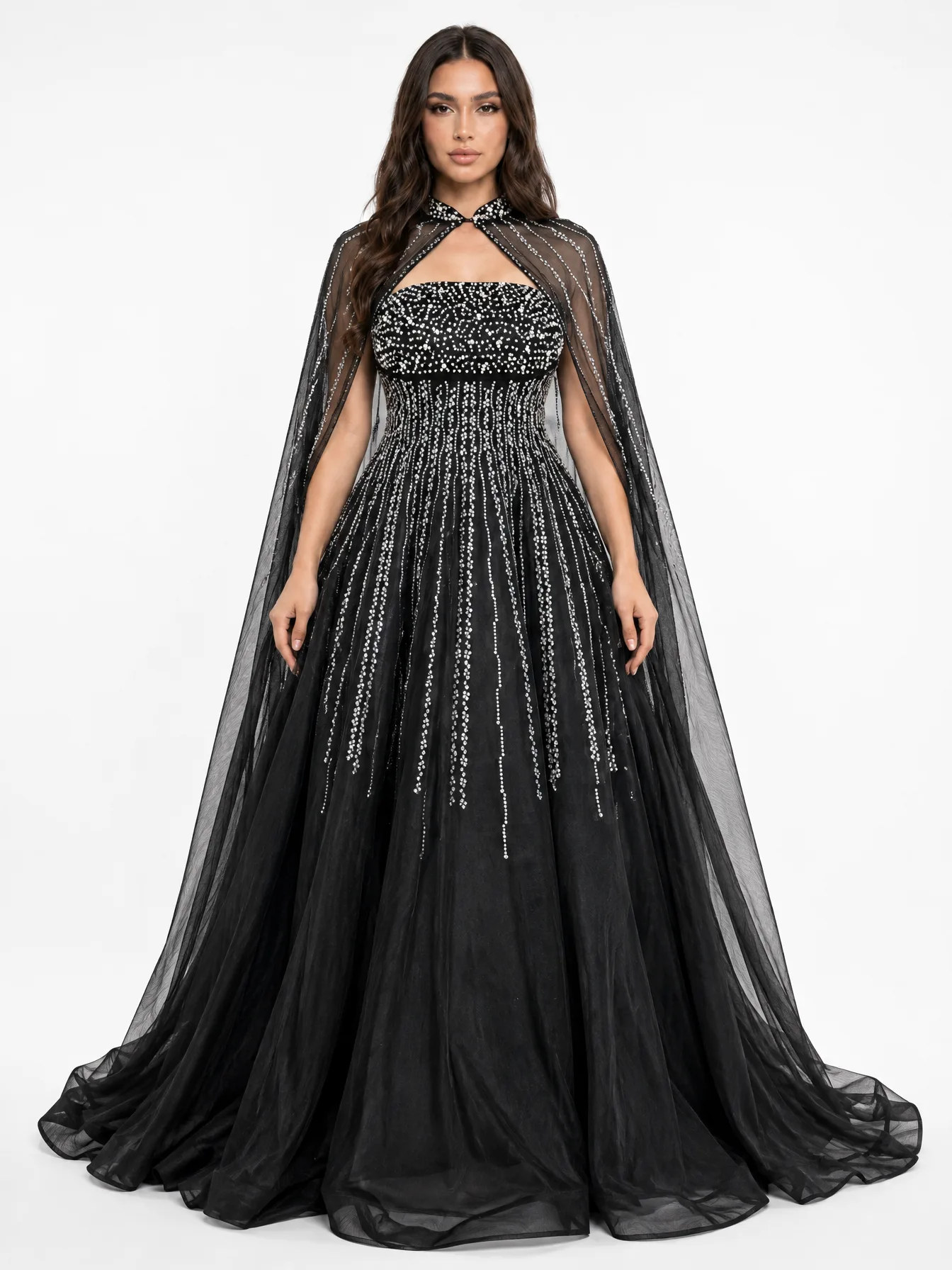
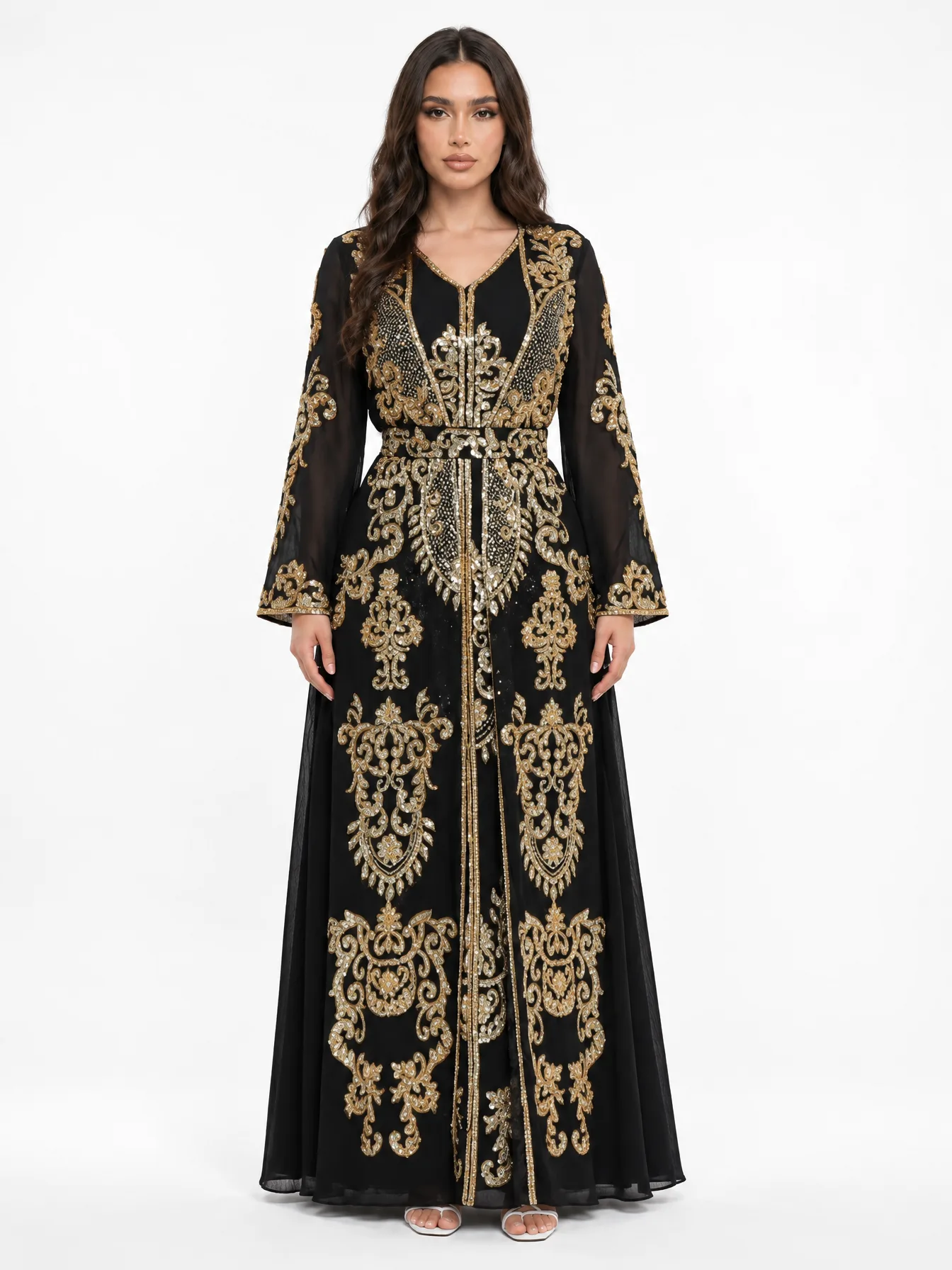
- Price the workmanship. Hand-beading, a cape or a two-piece set justifies a higher multiple than a simple silhouette, because customers can see the work. A piece such as a hand-beaded draped sash gown is priced on that visible detail, not on its fabric cost.
- Keep price points consistent. Customers compare across your rail, so a ladder of clear price points reads better than a different odd number on every tag.
Questions
What is a good markup on evening dresses?
There is no single right figure. Keystone, double the landed cost, is the usual starting point, and many boutiques need more to cover markdowns and try-on wear. Work out the margin your costs require, then convert it to a price with price = cost ÷ (1 − margin).
Is a 50% markup the same as a 50% margin?
No. A 50% markup on cost gives a 33.3% margin on the selling price. To make a 50% margin you need a 100% markup, which is keystone pricing.
Do prices in the UAE have to include VAT?
Yes, for a VAT-registered business. Article 38 of the UAE VAT Decree-Law says the advertised price of a taxable supply must include the tax, and the FTA applies this to price tags and catalogues. At 5%, the VAT inside a price is the price divided by 21. Confirm the details with the FTA or a tax adviser.
How do I calculate the landed cost of imported dresses?
Add the supplier's price, the share of freight and insurance per piece, customs duty (in the UAE tariffs range from 0 to 5%, with Dubai's rate given as 5% of the CIF value) and any clearance, courier and payment fees. Divide shared costs across every piece in the shipment.