A size run is the set of sizes you buy for one design in one colour. Plan it from a size curve, which is the share of your sales that each size takes, worked out from your own sales history and corrected for sizes that sold out early. Buy the middle of the curve deepest, cover the ends lightly, and keep part of your budget back for reorders instead of buying every size deep at the start. The rest of this guide shows how to build the curve, turn it into piece counts for small evening wear orders, plan colours against sizes, and manage the risk when the stock you buy can only be exchanged, not refunded.
What is a size curve?
A size curve is the percentage of demand that falls on each size. Blue Yonder, which builds retail planning software, gives a typical illustration: XS 10%, S 20%, M 30%, L 25%, XL 15%. A size ratio expresses the same thing in whole pieces, such as 1:2:3:2:1.
Three points matter for evening wear:
- Curves differ by category. Your curve for fitted gowns may not match your curve for kaftans.
- Curves differ by place. A boutique in one city or neighbourhood may skew larger or smaller than another.
- Curves change. Blue Yonder stresses that they are not static, so rebuild yours each season.
How do you build a size curve from your sales?
Use your own sales, not a supplier's default pack. In order:
- Pull a season or a year of evening dress sales by size. Count pieces, not value.
- Work out each size's share of the total.
- Correct for sell-outs. If a size ran out early, its sales understate demand. Blue Yonder calls this demand that vanished. Add back an estimate for the weeks it was missing, or look at requests you turned away.
- Separate full-price from markdown sales. Sizes that only sold on discount are telling you that you bought too many of them.
- For a new style with no history, borrow the curve of a similar design you already sell.
A hypothetical example. Suppose you sold 40 evening dresses last season: 4 in size 36, 9 in 38, 11 in 40, 9 in 42, 5 in 44 and 2 in 46. Your curve is 10%, 22.5%, 27.5%, 22.5%, 12.5% and 5%. If size 40 sold out a month early, nudge it up and take the extra from the ends.
How many of each size should you buy?
Decide the total for the design and colour first, then split it by the curve and round sensibly. Using the hypothetical curve above:
- 3 pieces: one each of 38, 40 and 42.
- 6 pieces: 36, 38, 40, 40, 42 and 44. The curve gives 0.6, 1.35, 1.65, 1.35, 0.75 and 0.3, which rounds to that spread.
- 10 pieces: one 36, two 38, three 40, two 42 and one 44, with the tenth piece going to whichever of 38 or 42 sold out faster last season, and 46 left to order on request.
With evening wear the numbers are small, so rounding decides the run. Round the middle sizes up and the outer sizes down, and accept that you will sometimes miss the smallest and largest customer. A supplier with short delivery and no minimum lets you order an edge size for a specific client instead of carrying it on spec.
If your supplier sells only fixed packs with one of every size, compare the pack with your curve before you buy. A pack of six sizes for a design you would buy as three pieces means three sizes that will probably end up on markdown.
How do standard international dress sizes compare?
Evening dresses are often labelled in European numeric sizes. According to Sizely's conversion chart, the usual equivalents are:
- EU 34: UK 6, US 2
- EU 36: UK 8, US 4
- EU 38: UK 10, US 6
- EU 40: UK 12, US 8
- EU 42: UK 14, US 10
- EU 44: UK 16, US 12
- EU 46: UK 18, US 14
The quick rule is UK = EU − 28 and US = EU − 32. Italian labels run higher, so check which system a supplier uses.
These conversions are a guide, not a guarantee. Cut varies between makers, which is why the European standard EN 13402 bases size labels on body measurements in centimetres. Ask every supplier for a size chart with bust, waist and hip in centimetres, and plan your run against those numbers. A clear chart looks like the one in this site's sizes and fit guide.
Does the cut of a dress change the size run?
Yes. The more a design depends on a close fit, the more sizes it needs.
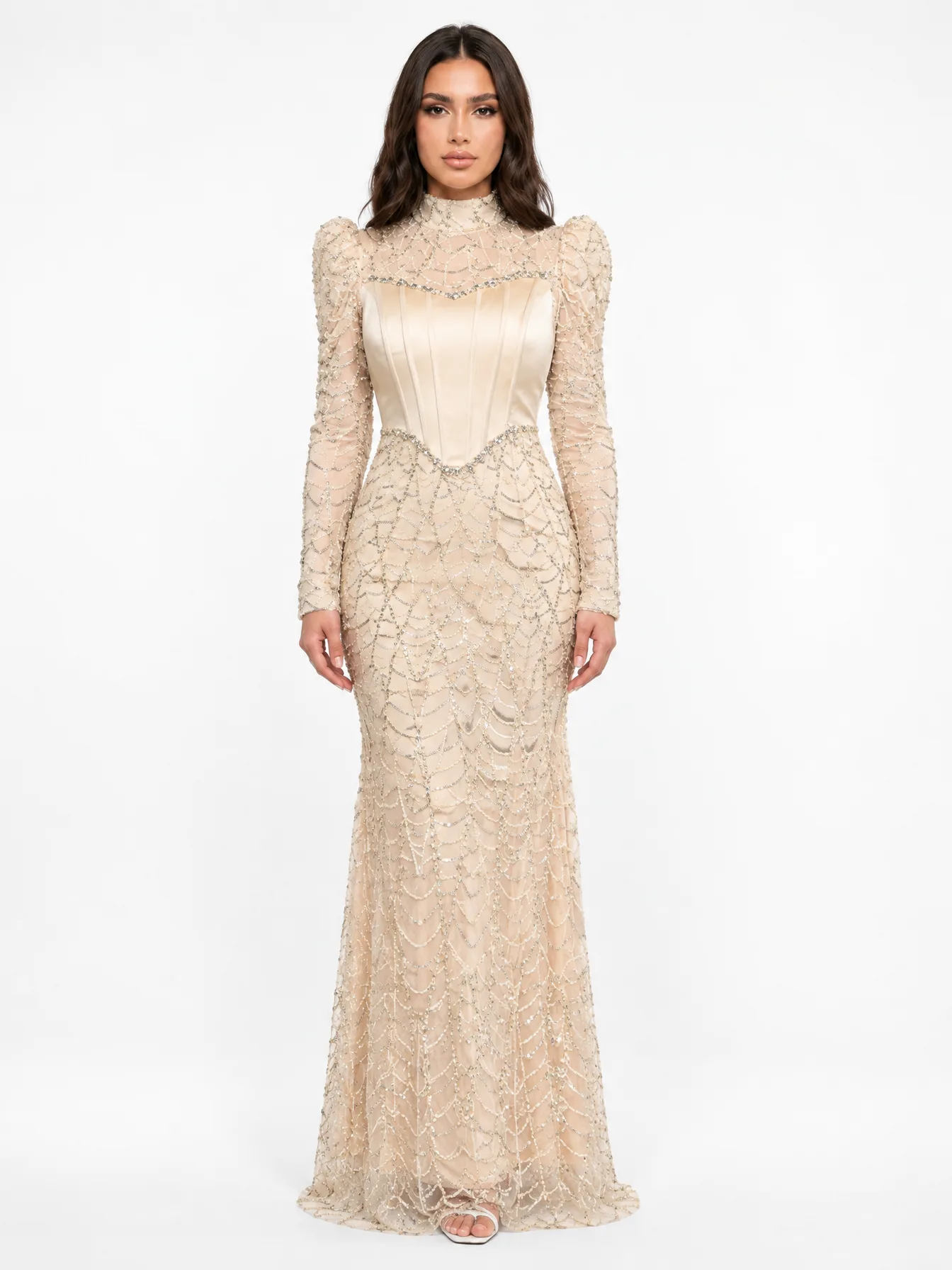
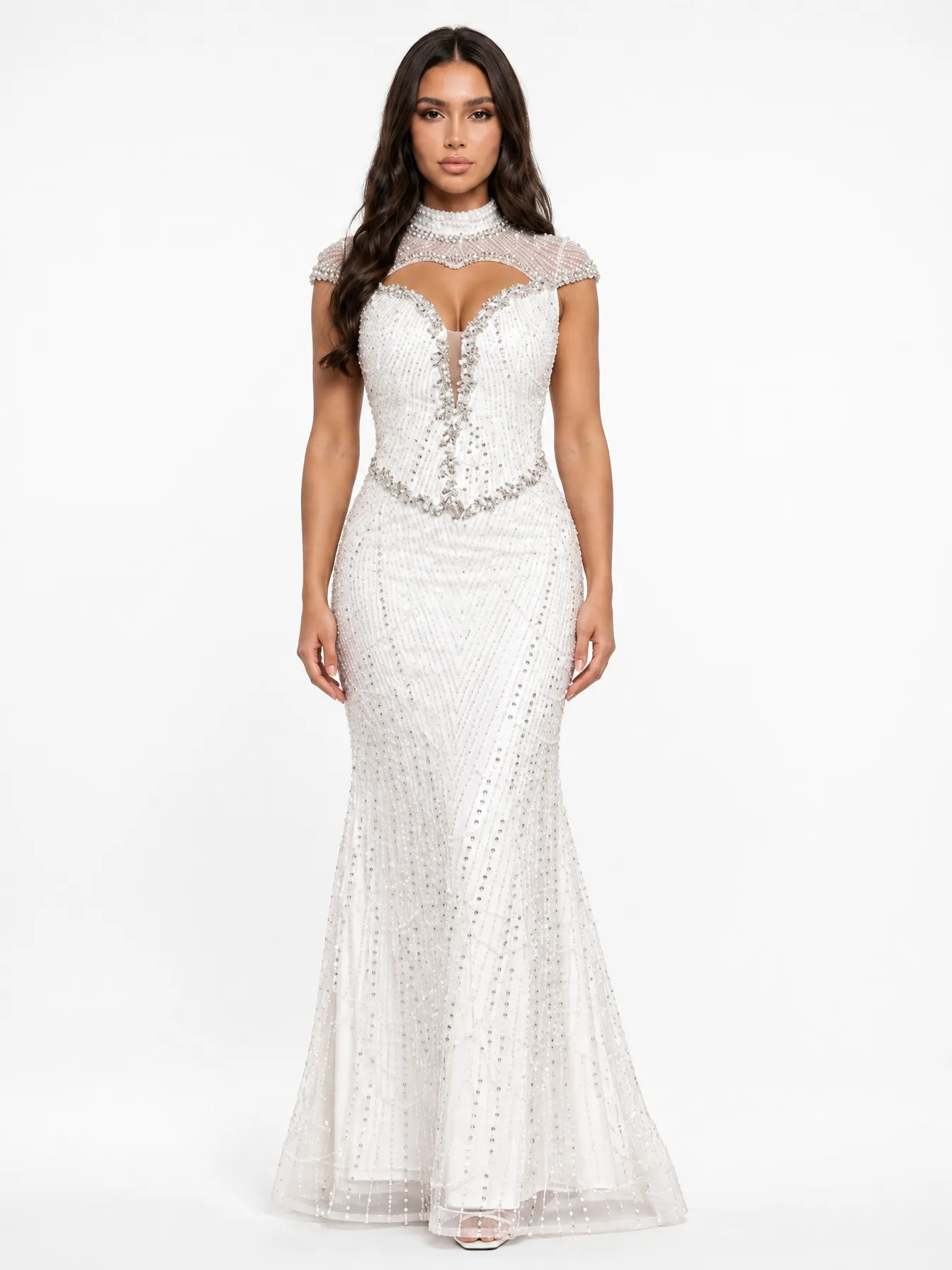
- Fitted and structured designs, such as mermaid skirts, boned corsets and sequinned sheaths, fit precisely at bust, waist and hip. A customer between sizes has little room, so these need the fuller run.
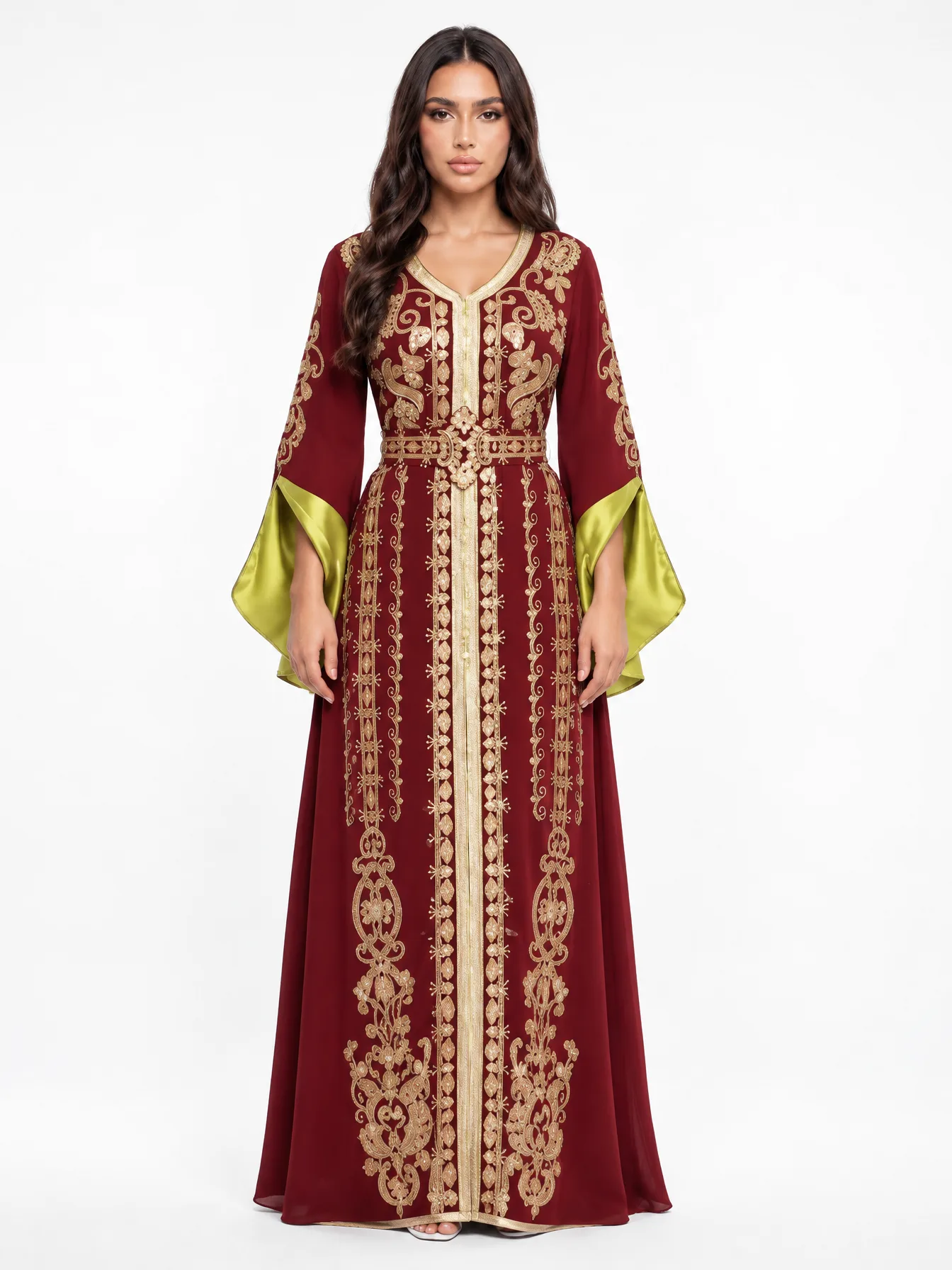
- Fuller and looser designs, such as ball-gown skirts, capes and kaftans, forgive more. A fitted bodice still needs the right bust and waist, but the skirt does not, and an open kaftan like the embroidered Arabic kaftan can cover a wider range with fewer sizes.
- Two-piece designs need checking piece by piece. Ask whether both parts come in the same size, or can be sized separately.
Evening dresses are frequently altered for length or fit after purchase. If your supplier's terms exclude altered pieces from exchange, an altered piece is yours to keep, so be sure of the size before anyone picks up a needle.
How do you plan colours against sizes?
Draw a simple grid for each design: colours down the side, sizes across the top, a piece count in each box. It shows at a glance where your money is going. Then:
- Give your core colour, the one that sells steadily season after season, the full run.
- Give fashion colours the middle sizes only, two or three pieces, and reorder if they move.
- Keep the total per colour in mind if your supplier prices by colour. On Lianora's ladder, for example, the sizes of one colour of a design add up towards a tier, but different colours count separately, so six pieces in one colour reach the 25% tier while three and three do not. Our guide to minimum orders and tiered pricing works through when the next tier is worth it.
A hypothetical twelve-piece buy of one design might be six in black (36, 38, 40, 40, 42, 44), three in burgundy (38, 40, 42) and three in champagne (38, 40, 42). The grid makes the trade-off visible: more colours give your customers choice, while fewer colours give you depth in the sizes that sell.
What is the risk when stock can only be exchanged?
Some suppliers do not refund at all. They exchange, within a short window and only for pieces in perfect condition. Lianora's terms work this way: exchanges within 7 days of delivery, unworn and in the original packaging, no refunds, and altered or special-offer pieces excluded. You can read them on the delivery and returns page.
For a size run, that means:
- Check sizes the day stock arrives. Measure one piece per size against the size chart while you can still exchange.
- Do not let customers try on a piece you might still exchange, if the supplier's terms say unworn.
- Line up your own policy with your supplier's. If you offer customers longer to exchange than your supplier gives you, the cost of every late size swap is yours.
When should you reorder sizes?
Reorder on evidence, and early enough to beat the next event. Track sales by size every week during the season. When a core size of a good design is down to its last piece, reorder it.
Work back from your supplier's delivery time. If pieces take 10–15 days to arrive, a size reordered on the first of the month should be on your rail by the middle of the month or soon after, in time for weddings at the end of it. Allow a few extra days around public holidays and your busiest wedding weeks.
Keep notes of every size you turned a customer away for. Those lost sales do not show up in your sales report, and they are exactly what your next season's curve needs.
Questions
Which evening dress sizes sell the most?
It depends on your customers, your city and the cut of the dress, so your own sales are the only reliable guide. Build a size curve from at least a season of sales, corrected for sizes that sold out, before deciding where to buy deepest.
Should a boutique stock one of every size?
Not usually for a small buy. One of every size spreads your money evenly across sizes that do not sell evenly. Cover the middle sizes first and order the edge sizes for specific customers, if your supplier's delivery time allows it.
How do I convert EU dress sizes to UK and US sizes?
Subtract 28 from the EU size for the UK size, and 32 for the US size. So an EU 38 is usually a UK 10 and a US 6. Cut varies between makers, so check the supplier's chart in centimetres too.
How many pieces of a new design should I order?
Start small: often two or three pieces in the middle sizes of one colour, if your supplier allows it. Watch how quickly they sell at full price, then reorder the sizes that move.