
Saudi Arabia is the larger market by the figures available, although those figures are not directly comparable, and it is the Gulf's biggest e-commerce market, with demand increasingly driven by local consumers, while the UAE is smaller but more international, with Dubai described as the region's shopping capital and an expatriate majority in its population. The practical differences for a boutique are VAT at 15% in Saudi Arabia against 5% in the UAE, a broader spread of styles and modesty preferences in the UAE, and the need to lead with Arabic in Saudi marketing.
How big are the UAE and Saudi evening-wear markets?
No official body publishes a figure for evening wear alone in either country, so the best guide is women's apparel as a whole.
- Saudi Arabia: the Saudi Fashion Commission's 2023 State of Fashion report, using Euromonitor International data, valued the Kingdom's women's apparel market at US$7.4 billion in 2022 and forecast growth of 20% by 2027. The same report valued overall fashion demand at US$24.6 billion in 2021, forecast to reach US$32 billion in 2025.
- UAE: Meydan Free Zone, citing Statista's women's apparel data for the UAE, wrote in April 2026 that the market reached US$5.47 billion in 2025.
These figures are not directly comparable. They were measured by different research firms (Euromonitor and Statista), for different years (2022 and 2025), and the two firms may define the market differently. Treat them as rough orders of magnitude, not a ranking. What they do show is that both markets are large, and that Saudi Arabia is the bigger of the two by the figures available.
Who is the evening-wear customer in each market?
In the UAE, the government's own fact sheet notes that expatriate residents outnumber UAE nationals. A Dubai or Abu Dhabi boutique therefore serves Emirati, other Arab, South Asian, European and other customers side by side, often in the same week. Ranges that mix Arab, Oriental and European styles tend to make sense there.
In Saudi Arabia, the Fashion Commission points to a shift towards local consumption by Saudi citizens, more women entering the workforce and growing tourism as drivers of apparel sales. The core customer is more likely to be local, which makes it easier to build a focused range and a loyal clientele, but also means your brand voice has to speak to her directly.
Do modesty preferences differ between Dubai and Riyadh?
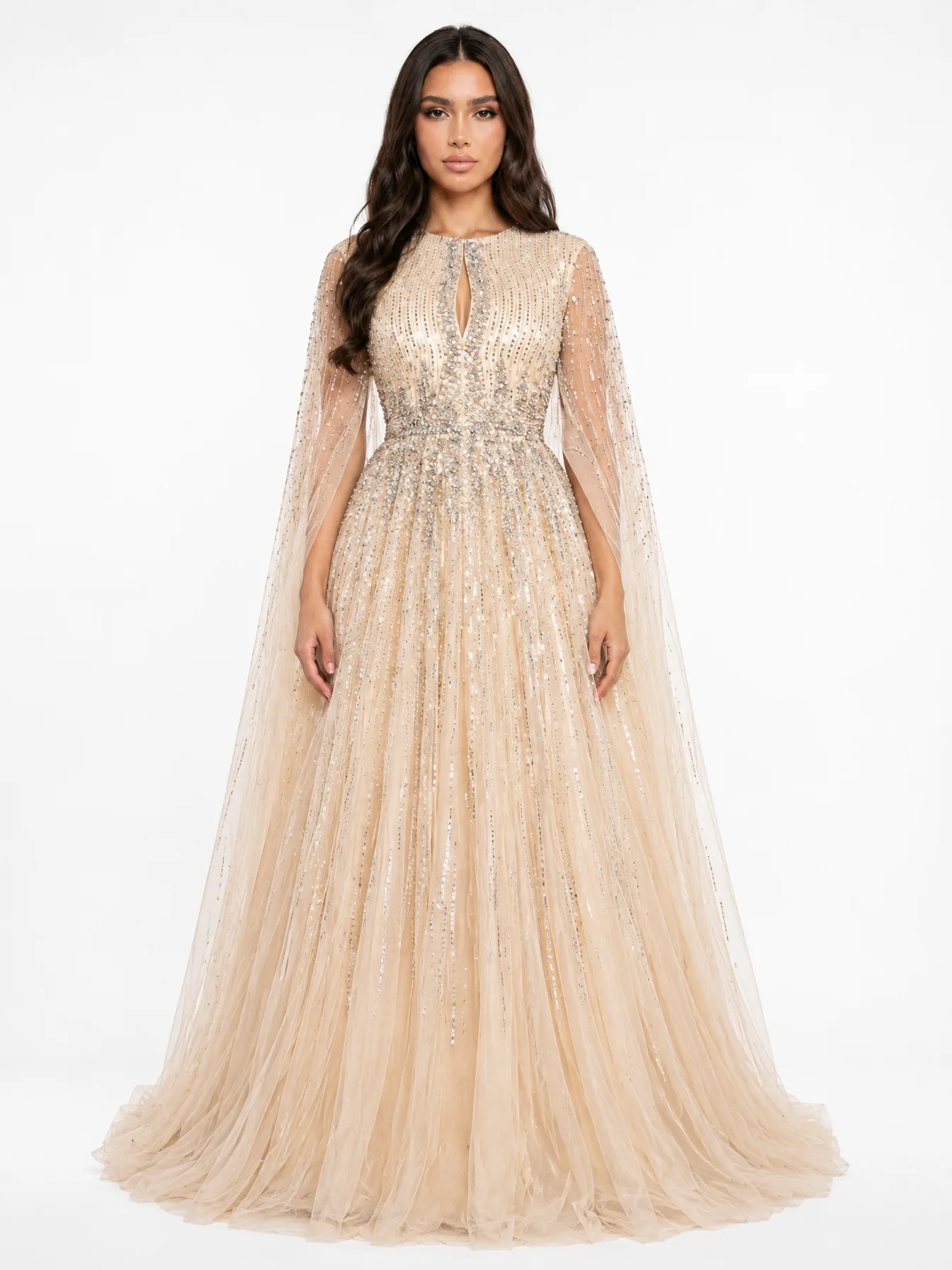
Modest dressing matters in both markets, but the spread is wider in the UAE. The Saudi Fashion Commission describes modest wear as a key driver of the regional fashion industry, and its report notes how abaya styles in the Kingdom keep multiplying. With a more international customer base, a UAE boutique will see requests that range from fully covered gowns to off-shoulder European cuts.
In practice:
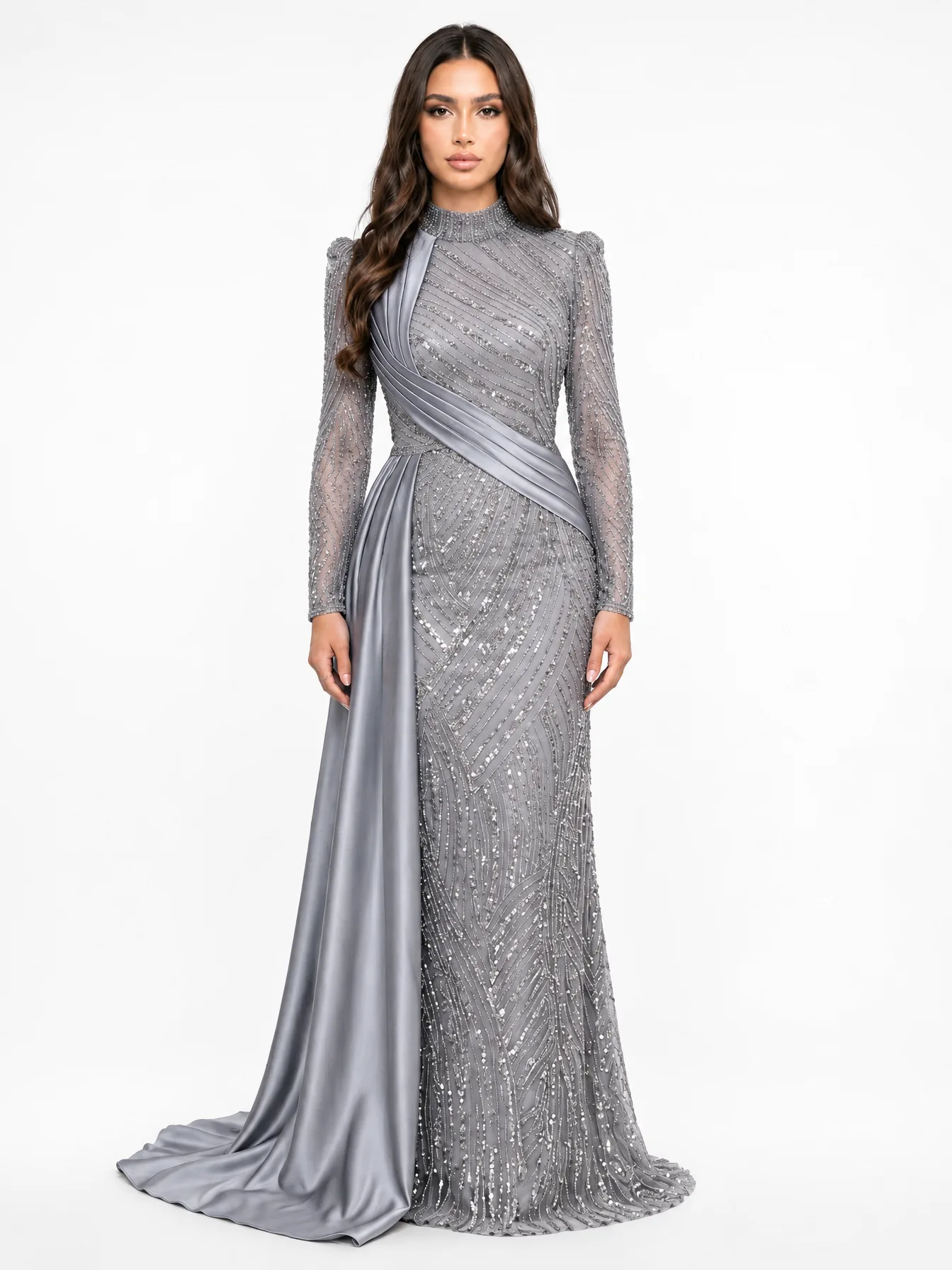
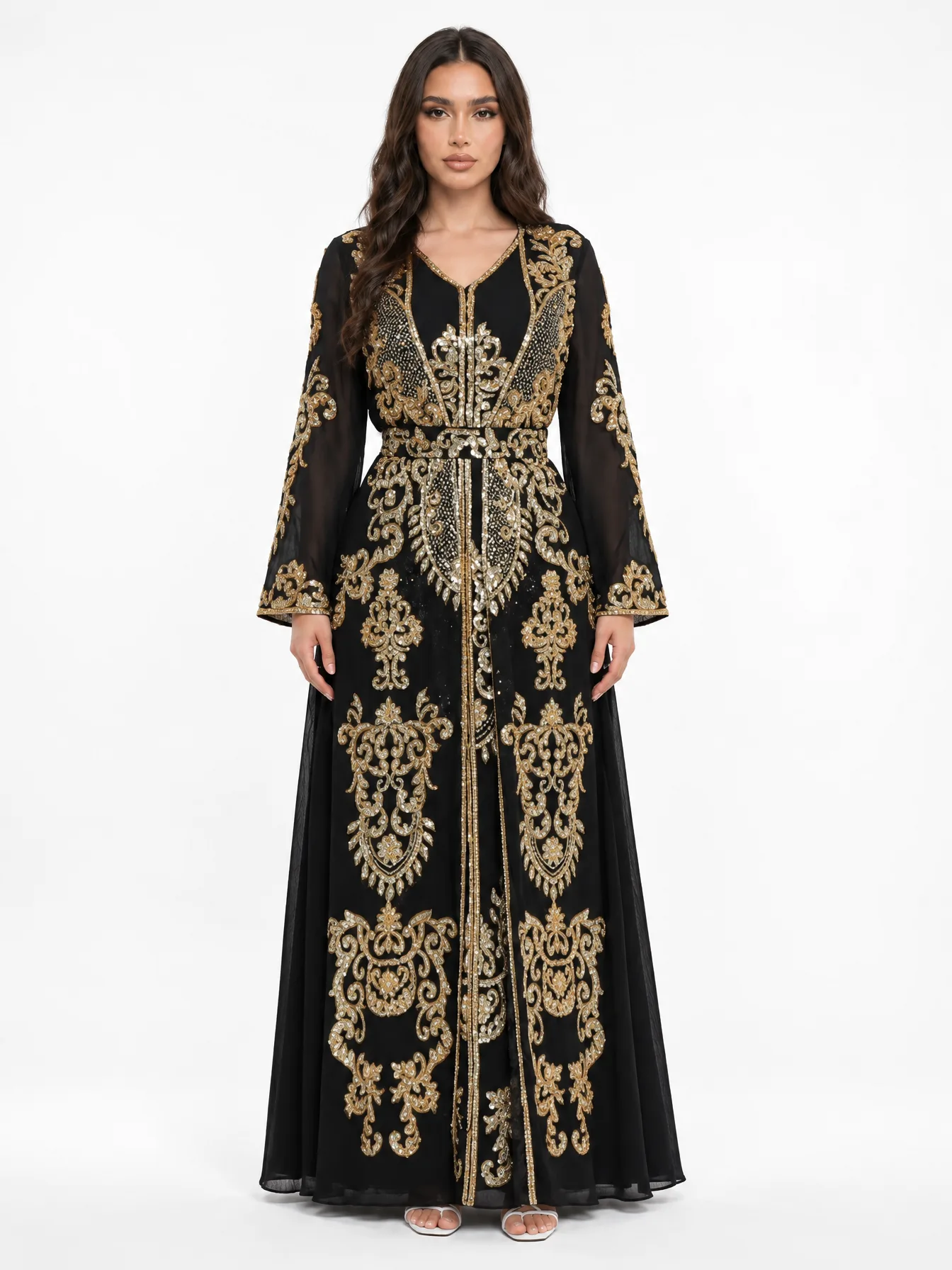
- For Saudi customers: lean on long sleeves, high necks, capes and kaftans, such as the hand-beaded draped sash gown or the two-piece hand-beaded kaftan.
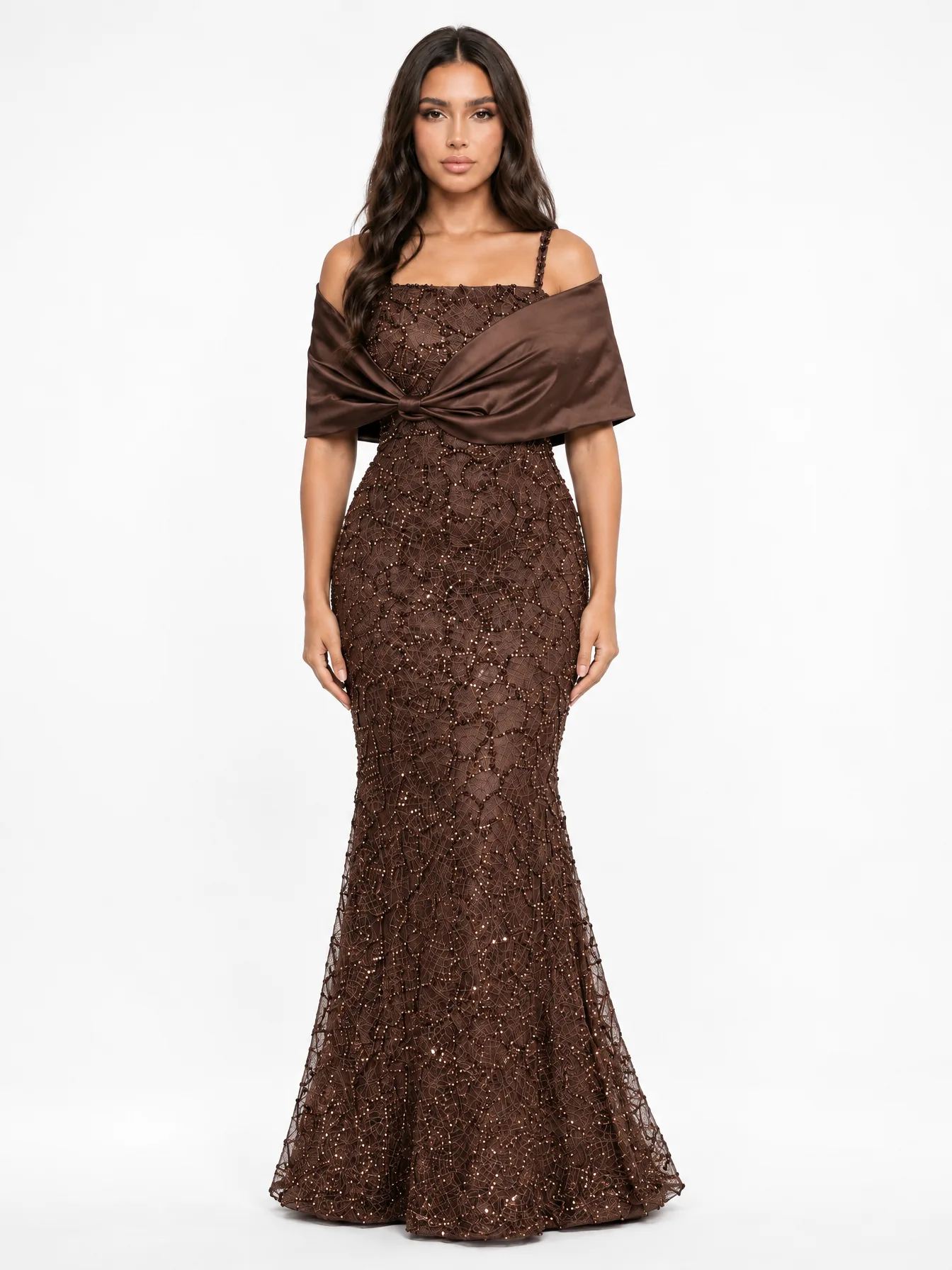
- For UAE customers: carry the same modest core, plus a smaller share of European shapes such as the draped-shoulder sequin gown.
- In both: expect customers to ask whether sleeves or linings can be added, and have an answer ready.
Our guide to merchandising modest evening wear goes further.
How does wedding culture shape demand in each country?
In both countries a family wedding is rarely one evening. Depending on the family, it can include an engagement, a henna night and the wedding itself, and a close relative may need a different outfit for each. That repeat demand is the backbone of evening-wear retail in the Gulf, but customs vary by family, tribe and nationality, so listen to how your own customers describe their events.
The differences for a boutique are mostly of mix rather than kind. A UAE boutique will also dress guests for Levantine, South Asian and Western weddings, each with its own expectations. A Saudi boutique is more likely to see repeat orders from the same extended families, which rewards keeping a record of who wore what. Our shopper guides to Emirati weddings and Khaleeji, Levantine and Western weddings show how customers think about it.
How do the retail landscapes compare?
Dubai sets the pace for organised retail. The Saudi Fashion Commission itself calls Dubai the region's present shopping capital, and Dubai's official retail calendar involves more than 1,000 brands and 4,000 outlets a year, anchored by the Dubai Shopping Festival and seasonal campaigns for Ramadan, Eid and summer. A UAE boutique competes with that calendar and can also ride it.
Saudi retail is growing fast from a different base. The Fashion Commission describes new shopping malls, rising tourism and a strong role for traditional souks alongside modern stores, under the retail focus of Vision 2030. It also notes that GCC luxury fashion sales reached US$9.7 billion in 2021, with Saudi Arabia a major contributor to that growth. For a boutique, the Saudi opportunity is less about festival footfall and more about building a name with local families.

How do online sales compare in the UAE and Saudi Arabia?
Saudi Arabia is the largest e-commerce market in the GCC by a wide margin, followed by the UAE, according to the Saudi Fashion Commission. Its report put e-commerce at 9% of total retail sales in the Kingdom in 2022, expected to reach 13% by 2025, and noted Vision 2030's target of 70% cashless payments by 2025. It also highlights social media and live-stream selling as fast-growing channels.
The UAE regulates online selling through its consumer protection law, which covers goods sold through e-commerce platforms registered in the UAE. Online businesses must give consumers details of their licensing body and information in Arabic about the product, its specifications, the terms, payment and warranty.
For most boutiques in either market, Instagram and WhatsApp do much of the selling. See selling evening dresses on Instagram and WhatsApp for a practical guide.
What are the VAT and invoicing differences?
Both countries introduced VAT at 5% on 1 January 2018. The UAE still charges 5%, with mandatory registration once taxable supplies and imports exceed AED 375,000 a year. Saudi Arabia raised its standard rate to 15% from 1 July 2020, according to ZATCA, the Saudi tax authority.
That gap changes your pricing. A dress priced at 1,000 before VAT sells at 1,050 in the UAE and 1,150 in Saudi Arabia, in local currency, if you keep the same margin. So check your Saudi price points against local competitors rather than copying UAE prices across.
Invoices need care in both markets:
- UAE: the invoice to a consumer must be dated and in Arabic, and you may add other languages.
- Saudi Arabia: ZATCA requires simplified tax invoices to be issued in Arabic and to show the total price including VAT.
Tax rules and thresholds change, so confirm your own position with the UAE Federal Tax Authority, ZATCA or a tax adviser before you register or price for either market. For the UAE side in detail, see UAE VAT basics for boutiques and customs duty on garments into the GCC. Lianora delivers to both countries and bears customs duties and taxes on delivery.
Why should Saudi marketing be Arabic-first?
Arabic is already a legal requirement on invoices in both countries, but the marketing logic differs. The UAE's official fact sheet notes that signs on commercial outlets are in Arabic and English, which reflects a mixed audience: bilingual product pages and captions are the norm there.
In Saudi Arabia, with a customer base that is more likely to be local, lead with Arabic and add English second:
- Write product names, descriptions and size guides in Arabic first, not as a translation afterthought.
- Caption posts and reels in Arabic, with Gulf-familiar terms such as فساتين سهرة and جلابية.
- Answer WhatsApp enquiries in Arabic by default.
- Check that prices shown include VAT, as invoices must.
Whichever market you sell in, consistency matters more than volume. A short, accurate Arabic description builds more trust than a long machine translation.
Questions
Is the Saudi fashion market bigger than the UAE's?
By the figures available, yes, but they are not directly comparable. The Saudi Fashion Commission's 2023 report, using Euromonitor data, valued Saudi women's apparel at US$7.4 billion in 2022, while Statista data cited by Meydan Free Zone puts the UAE's at US$5.47 billion in 2025. Different firms measured different years, so treat the comparison as a rough guide.
What is the VAT rate on clothing in Saudi Arabia and the UAE?
Saudi Arabia's standard VAT rate has been 15% since 1 July 2020, and the UAE's is 5%. In both countries the price on a consumer invoice should include VAT.
Do I need Arabic on my invoices and product pages?
On invoices, yes, in both countries. UAE consumer law requires invoices in Arabic, and ZATCA requires Saudi simplified tax invoices in Arabic. UAE online sellers must also give product information in Arabic, and in Saudi Arabia leading with Arabic is simply good marketing.
Can one supplier serve boutiques in both countries?
Yes, if it delivers across the GCC and handles customs. Lianora, for example, supplies boutiques in the UAE, Saudi Arabia and the rest of the GCC, delivers in 10 to 15 days from confirmation and bears customs duties and taxes on delivery. Check any supplier's terms for each country before you order.
Sources
- Saudi Fashion Commission: The State of Fashion in the Kingdom of Saudi Arabia 2023
- Meydan Free Zone: Ladies gowns tailoring business setup in Dubai (UAE women's apparel market, citing Statista)
- UAE Government portal (u.ae): Fact sheet
- UAE Government portal (u.ae): Value Added Tax (VAT)
- UAE Government portal (u.ae): Consumer protection
- ZATCA: About Value Added Tax (Arabic)
- ZATCA: Value Added Tax, simplified invoicing
- Dubai Media Office: Dubai unveils 2025 retail calendar